Worth Watching: What It Takes to Thrive in the AI Age
David Brooks joins Russell Moore to ask a different question about AI. Not whether it will take our jobs, but what kind of people we need to become to use it well.
Photo: David Brooks, 2022, by Jay Godwin (public domain), via Wikimedia Commons
In this episode of The Russell Moore Show, columnist and author David Brooks sits down with host Russell Moore to discuss his recent essay for The Atlantic, "The People Who Will Thrive in the AI Age."
Brooks starts from an unexpected place. AI is not mainly taking jobs or cutting workloads. It is changing how we relate to our own effort. That shift, he argues, will matter more for our futures than raw intelligence ever did.
He splits people into two groups. Some treat AI as a shortcut. They use it to think less and work less. Others treat it as a sparring partner. They use it to think harder and reach further. Brooks calls the second group people with a high need for cognition. They find hard thinking rewarding, not exhausting.
His guiding idea is worth keeping in mind: when intelligence becomes cheap, the will to use it well becomes the scarce resource.
For those of us working in education and development communication, this lands close to home. It is a question we return to often. What do we teach, and what do we protect, when a machine can already answer most of what we used to test?
Brooks's essay itself draws on new workplace research to make a sharper claim: AI is not reducing anyone's workload. Early data actually shows the opposite. People who adopt AI end up busier, not freer, taking on more tasks rather than fewer.
He sorts people into three groups. Those with a low need for cognition become "productive passengers," letting AI think for them and losing sharpness over time. Studies he cites found real drops in brain connectivity and critical thinking after heavy AI use. Those in the middle, the "reluctant optimizers," mean to stay engaged but drift into overreliance anyway. Only a third group, people with a genuinely high need for cognition, treat AI as a sparring partner rather than a shortcut. Brooks calls them mental marathoners.
His worry is cognitive polarization: a widening gap between people who use AI to grow and people who let it do their thinking for them. His answer is not to avoid AI, but to change how we use it. Ask it for hints, not answers. Draft your own thinking first, then bring in the machine to challenge it. Keep some tasks fully AI-free, to keep those mental muscles working.
Outside the Storm: Reuters Digital News Report 2026 Launches in Oslo
Fritt Ord, the University of Bergen, and Oxford's Reuters Institute presented this year's global media-trust findings — and asked what makes the Norwegian picture different
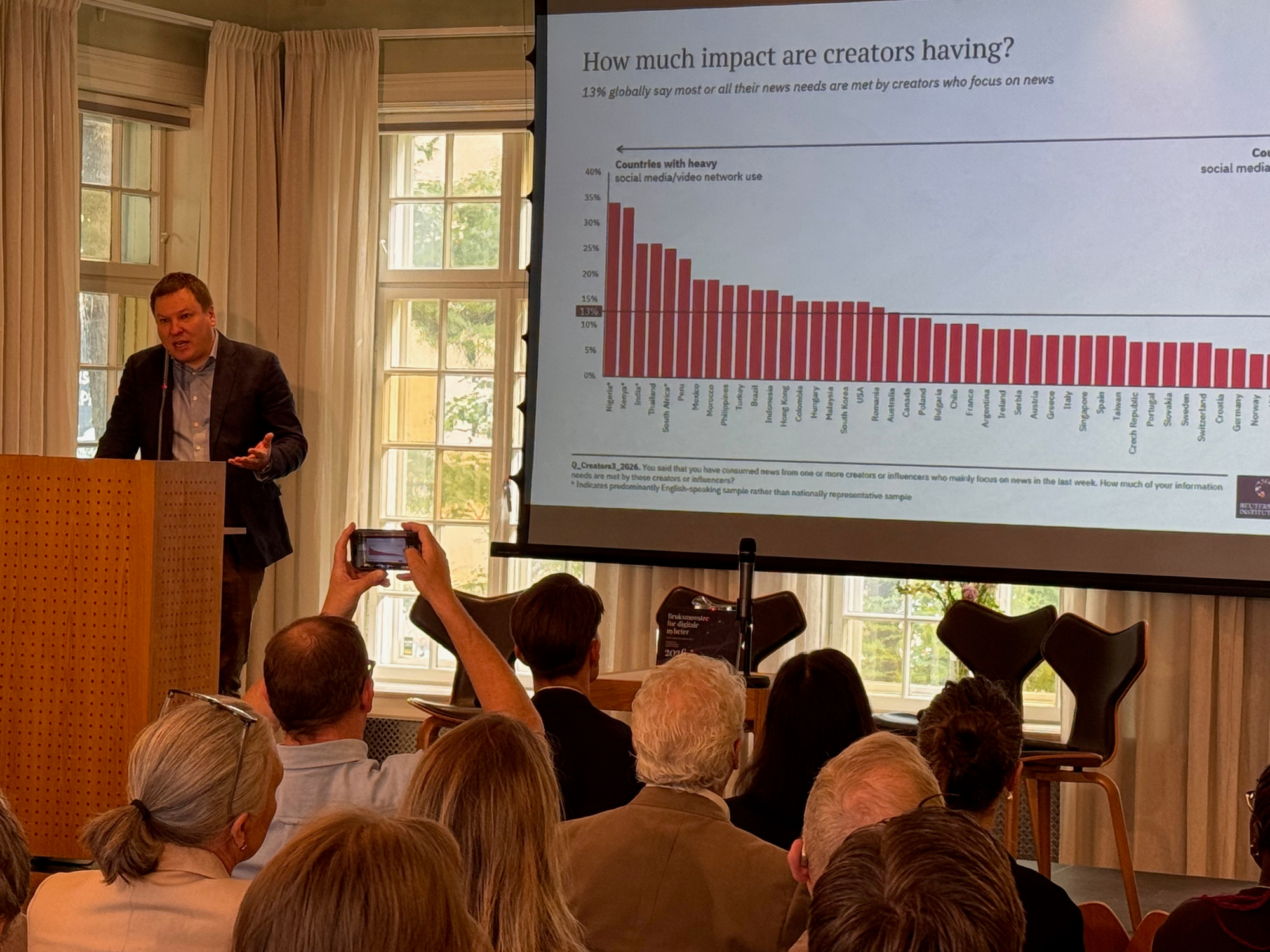
Fritt Ord, the University of Bergen, and the Reuters Institute for the Study of Journalism in Oxford held a breakfast seminar in Oslo on 16 June 2026 to present the Reuters Digital News Report 2026, the world's largest survey of digital news habits, covering 48 countries. Richard Fletcher of the Reuters Institute opened with the international findings, followed by Hallvard Moe of the University of Bergen — who has led the Norwegian portion of the study since 2017 — presenting the Norwegian results.
Fletcher's headline finding: trust in the media has fallen to some of the lowest levels recorded since the survey began. Willingness to pay for news, by contrast, remains among the highest in the world across Scandinavia — a pattern Fletcher described as holding steady, as usual.
In many countries the report paints journalism as an industry under real strain: falling willingness to pay, declining trust, growing news avoidance, and social platforms and independent news influencers increasingly competing with established newsrooms for attention. The Norwegian picture is more mixed. Moe noted that this year's data shows more news avoidance than in previous years, but said he does not read that trend as a threat to democracy in itself. TikTok, Instagram, and Snapchat continue to grow as sources of news, a shift that maps onto wider questions the report raises about how younger audiences now encounter journalism at all.
One consistent bright spot: Norway topped the global press freedom index for the tenth year running, even as most other countries surveyed saw their press freedom standing decline. The seminar's panel discussion — Fletcher, Moe, and VG commentator Shazia Majid, moderated by Fritt Ord's Tellef Solbakk Raabe — took up the gap between that formal press-freedom strength and the softer erosion of public trust the survey documents.
The full international report, the Norwegian sub-report, and the international press release are all available via Fritt Ord's write-up of the event: Fritt Ord: Reuters Digital News Report 2026 ↗.
Meta Settles With U.S. States Over Claims It Designed Instagram and Facebook to Addict Children
A landmark $17 billion agreement ends a mid-trial standoff over youth mental health — and its terms read like a checklist of what child-development research has been warning about for years
Meta has agreed to settle claims brought by a bipartisan coalition of states — more than two dozen of them party to a trial underway in a California federal court — alleging that Instagram and Facebook were deliberately designed to be addictive to children, that the company misled the public about the safety of its platforms, and that it improperly collected data from underage users. As CNN reported, the deal came together mid-trial, averting a jury verdict in one of the most consequential tests yet of whether social media companies can be held legally responsible for harm to young users. Meta did not admit wrongdoing.

Reported totals vary slightly by outlet — NPR puts the figure at $17 billion, CNBC at $16.7 billion, and CNN at $18 billion, likely reflecting different ways of counting Meta's total charge versus the direct state payout. The money is to be paid out over ten years and directed toward public health measures including crisis intervention services, after-school programming, and youth mental health initiatives. Alongside the payment, Axios reports Meta agreed to a set of binding product changes for under-18 users: a two-hour daily time limit on Facebook and Instagram, an overnight access block, reduced notifications during school hours, the option of a chronological (rather than algorithmically ranked) feed, and the removal of visible like-counts on posts. An independent auditor will monitor compliance, and Meta is barred from further misleading public statements about its safety features.
The settlement followed a string of related losses for Meta. As Reuters/US News noted, a jury in New Mexico had already ordered the company to pay $375 million after finding it misled consumers about platform safety, and a judge later added a further $567 million after determining Meta had created a public nuisance. Testimony in the current trial, covered by NPR, included an internal whistleblower's account that Meta's own research showed young users were exposed to harmful experiences at significantly higher rates than the company had acknowledged publicly — and that Instagram's leadership had continued to promote a wellbeing feature internally known to have very limited actual use among teens.
What's striking, from a research standpoint, is how closely the settlement's remedies map onto findings that have been accumulating for years about why adolescents are especially susceptible to these platforms. Developmentally, teenagers' brains are unusually responsive to social reward and peer feedback while the prefrontal cortex — the part responsible for impulse control and long-term judgment — is still years from maturity. That combination makes variable-reward mechanics (the unpredictable timing of likes, comments, and notifications) considerably harder for a teenager to self-regulate against than for an adult. Removing visible like-counts and offering a chronological feed both target that mechanism directly, by reducing the platform's reliance on unpredictable social validation and algorithmic amplification.
Sleep displacement is another well-documented pathway from social media use to poorer adolescent mental health, and the settlement's overnight access block addresses that pathway specifically rather than relying on general usage caps alone. Common Sense Media's own survey research — the same organization referenced in our previous post on AI and student thinking — has separately found that teens report feeling pressure to be constantly available and exceptional across academic and social domains, a pressure that late-night notifications and algorithmic feeds are understood to intensify rather than relieve.
None of this means the underlying design incentives disappear once the settlement is implemented — advertising-funded platforms still profit from attention, and enforcement will depend on the independent auditor's access and rigor. Axios also notes Meta issued an open letter urging TikTok and YouTube to adopt similar restrictions, with roughly $5 billion of its own settlement contingent on the other two platforms following suit. But the specificity of the remedies suggests the states' litigation strategy was built directly on the existing research base regarding youth vulnerability, rather than on generic calls for "safety."
The proposed settlement still requires approval from the presiding judge before taking effect.
Sources: CNN · CNBC · NPR · Axios · Reuters via US News
A Tree Before the Music: Reading Jeremy Eichler's Time's Echo
Getting ready for the MishMash project, one framework for thinking comes by way of a book
Getting ready to engage in the MishMash project described elsewhere on this site, a particular book comes to mind as a kind of framework for thinking: Jeremy Eichler's Time's Echo (Faber, 2023). Eichler is a longtime music critic at the Boston Globe, and it shows. Writing about the complex histories of composers, their work, and the circumstances under which it was created, a compelling story unravels. There is more to be said later, surely. But here are some glimpses from the preface of the book.

It opens not with a composer, a concert hall, or a musical score, but with a tree. The preface, titled "In the Shade of the Oak," tells the story of a single oak that stood in the Ettersberg forest outside Weimar. Goethe was said to have favored that tree; local legend has it he found there the kind of freedom and expansiveness he later wrote about in verse. In 1937, prisoners were put to work clearing the Ettersberg forest to build a Nazi concentration camp, Buchenwald. Their guards identified one tree that should not be felled. It was Goethe's oak. It was left standing, and the camp was built up around it.
For the SS administrators who ran Buchenwald, the tree functioned as a claim on German cultural inheritance — a living certificate connecting the camp, and the ideology behind it, to the same tradition of "genius" and "humanism" that Goethe himself represented. For the prisoners forced to live and die in its shadow, the same tree meant something entirely different: a mocking reminder of a civilization that had produced both Goethe and the men who now guarded them, and, in Eichler's phrase, a silent witness to what was being done there.
That doubleness is the whole argument of the preface. The oak is a story, a metaphor, and a matter of method. Eichler is not simply telling a striking anecdote to hook the reader — he is previewing the interpretive method the entire book uses in telling the story of four musical works. Just as the tree cannot be reduced to one side's version of what it signifies, the compositions by Strauss, Schoenberg, Shostakovich, and Britten that follow will each turn out to hold more than one truth inside them: witnesses to sorrow, to shame, to pain, to humanity and humanity gone wrong.
Eichler follows the oak forward to August 1944, when Allied bombers struck a munitions factory attached to Buchenwald and the tree was set on fire in the same raid that killed prisoners and SS personnel alike. What survived was a single carved fragment: a prisoner named Bruno Apitz salvaged a piece of the burned oak's heartwood and carved a human face into it. That carved face, smuggled out of the camp and eventually placed in a museum, becomes Eichler's first demonstration of the book's larger claim — that physical and cultural remnants can carry meaning forward across radically different eras and audiences.
And music does. Before Eichler asks the reader to listen closely to the four compositions he has chosen for the book, he asks us to look closely at a tree — to notice that beauty, heritage, and atrocity can share the same roots, and that remembering one without the other is not really remembering at all.
It is time to read and reflect on the entire book. Music and memory — whose memory, whose music, whose times? All of these issues are embedded in a story about an oak tree: a story about four composers coming to terms with the Second World War, in different ways, under different circumstances. Perhaps one would listen to these works differently after having read Eichler's book. Eichler says that music, in one sense, is an art form built from vibrating air and gone the instant it is played. And yet it is one of the most durable vessels of historical memory we have.